Understanding Mbps: What Does It Mean for Your Internet?
In today’s digital world, internet speed plays a major role in how smoothly we work, stream, game, study, and stay connected. While choosing a broadband plan, you’ve probably seen terms like 50 Mbps, 100 Mbps, or 500 Mbps.
But what exactly does Mbps mean, and how does it affect your daily internet experience?
This guide explains Mbps in simple words so you can choose the right internet speed for your needs.
What Does Mbps Mean?
Mbps stands for Megabits per second.
It measures how fast data travels from the internet to your device.
The higher the Mbps, the faster your internet connection can download or upload information.
For example:
- 50 Mbps = moderate speed
- 100 Mbps = fast internet
- 500 Mbps = ultra-fast fiber speed
Mbps is commonly used by internet service providers to describe broadband speed plans.
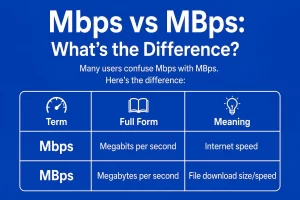
Mbps vs MBps: What’s the Difference?
Many users confuse Mbps with MBps.
Here’s the difference:
Important:
1 Byte = 8 bits
So if your internet plan is 100 Mbps, the actual download speed may appear around 12.5 MBps.
Why Mbps Matters for Internet Usage
Your internet speed affects almost everything you do online.
A higher Mbps connection helps with:
- Faster downloads
- Smooth video streaming
- Better online gaming
- Stable video calls
- Faster uploads
- Multiple connected devices
- Buffer-free OTT entertainment
Low internet speed can cause:
- Buffering videos
- Lag during gaming
- Interrupted meetings
- Slow downloads
- Poor video quality
How Much Mbps Do You Really Need?
The ideal internet speed depends on your daily usage and the number of connected devices.
Basic Internet Usage (20–50 Mbps)
Suitable for:
- Web browsing
- Social media
- Emails
- Music streaming
- Online shopping
Best for:
- 1–2 users
Streaming & Online Classes (50–100 Mbps)
Suitable for:
- HD video streaming
- Online learning
- Zoom meetings
- Work from home
Best for:
- Small families
Gaming & 4K Streaming (100–300 Mbps)
Suitable for:
- Multiplayer gaming
- 4K OTT streaming
- Large downloads
- Multiple smart devices
Best for:
- Medium to large households
Heavy Usage & Smart Homes (300 Mbps+)
Suitable for:
- Professional creators
- Smart home devices
- Large families
- Simultaneous streaming and gaming
Best for:
- High internet consumption users
Download Speed vs Upload Speed
Most people focus only on download speed, but upload speed is equally important.
Download Speed
Used for:
- Watching videos
- Browsing websites
- Streaming OTT apps
Upload Speed
Used for:
- Video calls
- Uploading files
- Cloud backups
- Live streaming
Fiber broadband usually offers much better upload speeds compared to traditional broadband technologies.
Does Higher Mbps Always Mean Better Internet?
Not always.
Internet performance also depends on:
- WiFi router quality
- Fiber vs DSL connection
- Network congestion
- Device capability
- Signal strength
- Latency and ping
A 100 Mbps fiber connection may perform much better than a slower cable or DSL connection during peak hours.
Fiber Broadband and Mbps
Fiber internet delivers:
- Higher speeds
- Stable connectivity
- Lower latency
- Better reliability
- Smooth multi-device performance
This is why fiber broadband is becoming the preferred choice for homes and businesses.
Common Internet Speed Myths
Myth 1: More Mbps Always Means Faster Browsing
Not always. Basic browsing doesn’t require extremely high speeds.
Myth 2: WiFi Speed Always Matches Plan Speed
Actual speed depends on router placement, connected devices, and WiFi quality.
Myth 3: One Device Needs 500 Mbps
Most devices use only a portion of total bandwidth unless doing heavy tasks.
How to Check Your Internet Speed
You can measure your internet speed using online speed test tools.
A speed test usually shows:
- Download speed
- Upload speed
- Ping/latency
Run tests while connected directly to WiFi for accurate results.
Tips to Improve Internet Speed
Place Your Router Properly
Keep the router in a central, open location.
Reduce Device Congestion
Too many connected devices can reduce speed.
Upgrade Old Routers
Older routers may not support high-speed fiber plans.
Use Fiber Broadband
Fiber provides more stable and consistent performance.
Mbps for Modern Digital Life
Today’s homes use internet for:
- Streaming OTT apps
- Smart TVs
- Gaming
- Remote work
- Online education
- CCTV cameras
- Smart home devices
This is why choosing the right Mbps plan is important for a smooth online experience.
Future of Internet Speeds in India
Internet usage in India is growing rapidly.
With:
- 4K streaming
- Cloud gaming
- AI tools
- Smart homes
- Remote work
- IoT devices
users will need faster and more reliable broadband connections.
Fiber internet is expected to dominate future broadband infrastructure across India.
Final Thoughts
Understanding Mbps helps you choose the right internet plan based on your daily usage.
The right speed ensures:
✔ Smooth streaming
✔ Faster downloads
✔ Better gaming
✔ Stable video calls
✔ Reliable connectivity
✔ Faster downloads
✔ Better gaming
✔ Stable video calls
✔ Reliable connectivity
For modern households, fiber broadband with stable Mbps speed offers a better internet experience compared to traditional broadband technologies.
As digital usage continues to grow, choosing the right internet speed will become even more important for homes, students, gamers, and businesses.