Understanding Fair Usage Policy (FUP) in Internet Plans
When choosing a broadband or mobile internet plan, you may come across the term Fair Usage Policy (FUP). Many users see “unlimited data” in advertisements, but later notice their speed drops after a certain usage limit. This happens because of FUP in internet plans.
Understanding how FUP in Telecom works helps you choose the right internet plan, avoid unexpected speed reductions, and manage your data usage more effectively.
This guide explains the FUP in internet meaning, how it works, whether FUP is monthly, and what FUP speed means in practical terms.
What Is FUP in Internet Plans?
Fair Usage Policy (FUP) is a rule used by
internet service providers to ensure that all users on a network get fair access to bandwidth.
In simple terms, it allows users to enjoy high-speed data up to a certain limit, after which the internet speed may be reduced for the rest of the billing cycle.
Simple Definition
FUP in internet meaning:
A policy where users receive full internet speed up to a specified data limit, after which the speed is reduced, but internet access continues.
For example:
- A broadband plan may offer 100 Mbps speed up to 3 TB of data usage.
- Once the 3 TB limit is crossed, the speed may drop to 10 Mbps until the next billing cycle.
This approach helps prevent excessive
bandwidth consumption by a small number of users that could affect the overall network performance.
Why FUP Exists in Telecom Networks
The FUP in Telecom industry exists mainly to manage network resources efficiently.
Internet infrastructure is shared among many users. Without usage limits, a few extremely heavy users could consume large portions of the network bandwidth, affecting service quality for everyone else.
FUP helps maintain:
- Network stability
- Fair bandwidth distribution
- Consistent speeds for most users
- Reduced network congestion
It ensures that internet service remains reliable across thousands of connected households and devices.
How FUP Works in Internet Plans
Most broadband providers follow a structured process when implementing FUP in internet plans.
Step 1: High-Speed Data Allocation
Users get a certain amount of data at full advertised speed.
Example:
- 200 Mbps speed
- 3 TB monthly FUP limit
Step 2: Data Consumption Tracking
The internet provider tracks the total data consumed during the billing cycle.
Step 3: Speed Reduction After Limit
Once the FUP limit is crossed:
- The internet still works.
- The speed is reduced.
Example:
- 200 Mbps before FUP
- 10 Mbps after FUP
The speed resets back to full capacity when the next billing cycle begins.
Is FUP Monthly?
A common question users ask is: Is FUP monthly?
In most broadband plans, yes : FUP is applied on a monthly billing cycle.
This means:
- Data usage is counted every month.
- The FUP limit resets at the start of the next billing period.
However, some telecom providers may offer:
- Daily FUP limits
- Weekly usage limits
- Truly unlimited plans without FUP
Always check the plan details before subscribing.
What Does FUP Speed Mean?
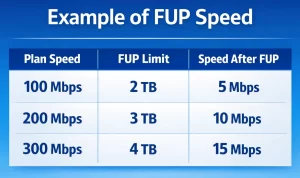
FUP speed refers to the reduced internet speed you receive after exceeding the data limit defined in the Fair Usage Policy.
FUP Speed Example:
While the speed decreases, the connection remains active so users can continue browsing, streaming, or working online.
Real-World Example of FUP in Internet Usage
Consider a typical family using the internet for multiple activities:
- Streaming movies in 4K
- Online gaming
- Work-from-home video calls
- Cloud backups
- Smart home devices
A household like this may easily consume 1–2 TB of data every month.
If their plan has a 3 TB FUP limit, they can comfortably enjoy full speeds throughout the month. However, extremely heavy downloads or continuous streaming could push them beyond the limit.
Once the limit is reached, speeds slow down temporarily until the next billing cycle.
How Much Data Do Typical Activities Use?
Understanding data usage helps avoid hitting FUP limits unexpectedly.
Approximate data consumption:
- HD streaming: 3 GB per hour.
- 4K streaming: 7–15 GB per hour.
- Online gaming: 50–150 MB per hour.
- Video calls: 1–3 GB per hour.
- Large game downloads: 50–100 GB.
Households with multiple users may consume hundreds of gigabytes each week.
This is why many modern broadband plans now offer high FUP limits like 3 TB or more.
Common Misconceptions About FUP
Many internet users misunderstand how FUP in internet plans works.
Misconception 1: FUP Means Internet Stops
Reality:
The internet continues working. Only the speed is reduced.
Misconception 2: Unlimited Plans Have No Limits
Reality:
Many “unlimited” plans still have an FUP limit where speed is reduced after a certain usage.
Misconception 3: FUP Applies Daily
Reality:
Most broadband providers apply FUP on a monthly basis, not daily.
Tips to Avoid Reaching FUP Limits
Heavy internet users can manage their usage more efficiently with a few simple steps.
Monitor Data Usage
Most routers and broadband apps allow you to track monthly data consumption.
Optimize Streaming Quality
Streaming in HD instead of 4K can significantly reduce data usage.
Schedule Large Downloads
Downloading large files during specific periods helps control monthly usage.
Choose Higher FUP Plans
If your household has multiple users, selecting a plan with higher FUP limits ensures uninterrupted high-speed internet.
How Internet Plans Are Changing Beyond FUP
The telecom industry is gradually evolving beyond traditional FUP in Telecom models.
With growing demand for streaming, cloud services, and remote work, many providers now offer:
- Higher FUP limits
- Truly unlimited plans
- Gigabit broadband
- Fiber-based infrastructure
Fiber networks can handle significantly larger data volumes, which allows providers to offer more flexible usage policies.
FAQs About FUP in Internet Plans
What is FUP in internet?
FUP (Fair Usage Policy) is a rule where internet providers allow full-speed data up to a specific limit. After reaching that limit, the speed is reduced, but internet access continues.
Is FUP monthly?
Yes. In most broadband plans, the FUP limit is calculated monthly and resets at the beginning of the next billing cycle.
What does FUP speed mean?
FUP speed means the reduced internet speed you receive after exceeding the allowed high-speed data limit in your plan.
Does the internet stop after FUP?
No. The connection continues working, but the speed becomes slower until the next billing cycle resets the limit.
How much FUP data is enough for a home?
For a typical family with streaming, gaming, and work-from-home needs, 2–3 TB per month is usually sufficient.
Final Thoughts
Understanding FUP in internet plans helps users make informed decisions about their broadband services. While the term may sound restrictive, the Fair Usage Policy in Telecom is primarily designed to ensure fair network access for all users.
By choosing the right plan, monitoring usage, and understanding how FUP works, households can enjoy fast and reliable internet without unexpected slowdowns.