
Dedicated Internet vs Shared Internet: What’s the Real Difference?
When choosing an internet connection, whether for a home, startup, or large enterprise, you’ll often come across two terms: dedicated internet and shared internet. On the surface, both promise connectivity, but in real-world usage, the experience, reliability, and performance can be dramatically different.
This article breaks down the real difference between Dedicated Internet vs Shared Internet, explains how each works, who should use which, and helps you make a confident, future-ready decision, without jargon or sales talk.
What Is a Dedicated Internet Connection?
A dedicated internet connection provides exclusive bandwidth to a single user or organization. The speed you purchase is reserved only for you and is not shared with anyone else.
This type of connection is commonly delivered as a leased line internet connection, especially for businesses.
Key Characteristics of Dedicated Internet
- Guaranteed bandwidth at all times
- Symmetrical upload and download speeds
- Low latency and consistent performance
- Backed by Service Level Agreements (SLAs)
- Designed for mission-critical usage
In simple terms, if you buy a 100 Mbps dedicated connection, you get that speed consistently—day or night.
What Is a Shared Internet Connection?
A shared internet connection means multiple users access the same pool of bandwidth. This is the most common setup for homes and small residential users.
Your speed depends not only on your plan, but also on how many people are using the network at the same time.
Key Characteristics of Shared Internet
- Bandwidth is shared among multiple users
- Speed fluctuates during peak hours
- Download speeds are prioritized over upload speeds
- No guaranteed performance
- Cost-effective for everyday usage
This is what most people experience as standard residential broadband.
The Core Difference: Internet Bandwidth Allocation
The biggest difference between dedicated and shared internet lies in how bandwidth is allocated.
Dedicated Internet Bandwidth Allocation
- One user, one connection
- No contention with other users
- Predictable speed and performance
Shared Internet Bandwidth Allocation
- Multiple users share the same capacity
- Performance depends on network congestion
- Slower speeds during evenings or peak hours
This distinction directly affects reliability, speed consistency, and user experience.
Dedicated Internet vs Shared Internet: Side-by-Side Comparison
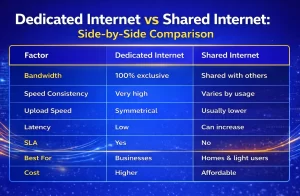
Real-World Use Cases: Where the Difference Matters
Businesses and Enterprises
For businesses, internet downtime isn’t just inconvenient—it’s expensive.
A dedicated internet connection is essential for:
- Cloud-based applications
- VoIP and video conferencing
- Data backups and server access
- Payment systems and ERP tools
- Remote work environments
Even small delays or drops can affect productivity, customer trust, and revenue.
Homes and Residential Users
A shared internet connection works well for:
- Streaming OTT platforms
- Browsing and social media
- Online classes
- Casual gaming
- Smart home devices (to a point)
However, performance can dip when many devices or users are active simultaneously.
Residential Broadband vs Business Internet: A Practical View
Many users underestimate how different residential broadband vs business internet actually is.
Residential Broadband
- Designed for burst usage
- Optimized for downloads
- Accepts speed variation
- No uptime guarantees
Business Internet (Dedicated)
- Designed for continuous usage
- Optimized for uploads and real-time tasks
- Stable even during peak hours
- Backed by contractual uptime
This is why running a business on a residential connection often leads to frustration.
Why Dedicated Internet Costs More (and When It’s Worth It)
Dedicated internet is priced higher because:
- Infrastructure is reserved for one user
- Capacity planning is guaranteed
- Maintenance and monitoring are proactive
- SLAs ensure uptime and response times
It’s worth the investment when:
- Downtime affects operations
- You rely on cloud services
- You need stable upload speeds
- Your business scales digitally
For many organizations, the cost of downtime exceeds the cost of the connection.
Common Misconceptions to Avoid
“High Speed Means Dedicated”
Not true. A shared connection can advertise high speeds but still slow down under load.
“Small Businesses Don’t Need Dedicated Internet”
Even a team of 10 using cloud tools can face issues with shared bandwidth.
“Dedicated Internet Is Only for Enterprises”
Today, many SMEs, clinics, schools, and startups use dedicated connections successfully.
How Latency and Upload Speeds Change the Experience
Most people focus on download speed, but latency and upload speed matter more for modern usage.
Dedicated Internet Advantages
- Faster video calls
- Smoother cloud access
- Better real-time collaboration
- Stable VPN connections
Shared connections often struggle here, especially during peak usage.
Smart Homes and Internet Choice
As homes become smarter, shared connections are being pushed harder.
Smart homes may include:
- Security cameras
- Smart TVs and streaming
- Voice assistants
- Multiple phones and laptops
While shared internet works today, high device density can cause performance issues—making higher-quality connections more important over time.
How to Choose the Right Option
Ask yourself these questions:
- Do I need guaranteed speed at all times?
- Does downtime affect my work or business?
- Do I rely on cloud tools or video calls?
- Is upload speed important for my usage?
If the answer is “yes” to most, dedicated internet is the safer choice.
FAQs
What is the main difference between dedicated and shared internet?
Dedicated internet offers exclusive bandwidth, while shared internet divides bandwidth among users.
Is dedicated internet faster than shared internet?
Not always on paper, but it is far more consistent in real-world usage.
Who should use shared internet?
Homes and light users with flexible performance needs.
Who should use a dedicated internet connection?
Businesses, remote teams, and anyone needing stable, reliable connectivity.
Is dedicated internet the same as a leased line?
Yes. A leased line internet connection is a form of dedicated internet with guaranteed performance.
Can shared internet be reliable?
It can be reliable for general use, but performance varies with network load.
Does dedicated internet improve video conferencing?
Significantly. Low latency and symmetrical speeds make calls more stable.
Is the dedicated internet future-proof?
More than shared connections, especially as cloud usage and real-time applications grow.
Final Thoughts
The debate around Dedicated Internet vs Shared Internet isn’t about which is “better” universally; it’s about which is right for your needs.
Shared internet is cost-effective and suitable for everyday home use. Dedicated internet, on the other hand, is built for reliability, performance, and growth.
As digital dependence increases through cloud services, remote work, and real-time applications, understanding this difference helps you avoid connectivity problems before they impact your productivity.
The right internet connection isn’t just about speed.
It’s about consistency, reliability, and readiness for what comes next.
It’s about consistency, reliability, and readiness for what comes next.