How Future Technologies Will Increase Internet Demand
The internet is no longer just a tool for browsing websites or sending emails. It has become the backbone of modern life. As future technologies evolve, future technologies and internet demand will grow together, faster, deeper, and more critically than ever before.
From smart homes and autonomous systems to AI-driven services and smart cities, the next decade will place unprecedented pressure on networks. This article explains why high-speed internet demand is rising, how emerging technologies drive that demand, and what it means for users, businesses, and infrastructure providers.
The Big Shift: Why Internet Demand Is Growing Faster Than Ever
In the past, internet usage was mostly one-way and passive—reading content, downloading files, or watching videos. Today, it is real-time, interactive, and data-heavy.
Three fundamental changes are driving this shift:
- More connected devices per user
- Real-time data processing instead of delayed responses
- Higher quality content (4K, VR, live streams, cloud apps)
Future technologies don’t just “use” the internet—they depend on it to function correctly.
Smart Homes: Small Devices, Massive Data Needs
Smart homes are one of the clearest examples of rising internet demand.
How smart homes increase internet usage
A modern smart home may include:
- Security cameras streaming HD or 4K video 24/7
- Smart TVs running multiple OTT platforms
- Voice assistants processing cloud-based commands
- Smart lighting, locks, thermostats, and appliances
- Mobile devices, laptops, and tablets are connected simultaneously
Each of these devices sends and receives data continuously. On their own, the data usage seems small. Together, they create constant bandwidth consumption.
Why speed and stability matter
Smart homes rely on instant response. Delays of even a few seconds can:
- Break voice assistant interactions
- Delay security alerts
- Cause buffering or device disconnections
This is why smart homes and internet usage are directly tied to high-speed internet demand, especially low-latency fiber connections.
Artificial Intelligence: The Silent Bandwidth Consumer
AI is often invisible to users, but it is one of the largest drivers of internet demand.
How AI increases data consumption
AI-powered systems rely on:
- Continuous data uploads to cloud servers
- Real-time model processing
- Instant feedback loops
Examples include:
- AI-powered search and recommendations
- Smart cameras with facial or motion recognition
- Virtual assistants and chatbots
- Predictive maintenance systems
Unlike traditional software, AI systems learn and adapt constantly, which means constant data transfer.
What this means for networks
AI shifts internet usage from occasional bursts to persistent, background data flow. This makes high-capacity, always-on connections essential.
IoT and Connected Devices: Scale Changes Everything
The Internet of Things (IoT) is not about one device—it’s about millions of devices operating together.
Where IoT is expanding
- Smart homes
- Healthcare monitoring systems
- Industrial automation
- Agriculture and logistics
- Smart cities
Each sensor may send small packets of data, but at scale, IoT creates massive aggregate demand.
Key challenge: reliability over raw speed
IoT networks require:
- Consistent uptime
- Low latency
- Minimal packet loss
This is why legacy copper networks struggle and why fiber broadband future planning is critical.
Smart Cities: Internet as Core Infrastructure
Smart cities take everything we see in smart homes and multiply it across entire urban environments.
How smart cities increase internet demand
Smart city systems include:
- Traffic management using live video feeds
- Public WiFi networks
- Smart surveillance and emergency response systems
- Utility monitoring (water, electricity, waste)
- Connected public transport
All these systems depend on real-time data exchange.
Why infrastructure matters
In smart cities, internet connectivity is no longer optional—it becomes critical infrastructure, similar to roads or electricity.
This is why smart cities internet infrastructure planning focuses heavily on fiber networks, redundancy, and scalability.
Cloud Computing: Moving Workloads Off Devices
Cloud computing shifts storage and processing from local devices to remote data centers.
Why does this increase internet usage?
Cloud-based services include:
- Online collaboration tools
- Cloud storage and backups
- SaaS platforms for businesses
- Streaming-based software and gaming
Instead of occasional downloads, users now interact with the cloud continuously.
Real-world impact
- Work-from-home setups require stable upload and download speeds
- Businesses rely on constant cloud access
- Downtime equals productivity loss
This shift makes high-speed internet demand a business necessity, not a luxury.
Remote Work, Education, and Virtual Collaboration
The future of work and education is hybrid, distributed, and digital-first.
What modern usage looks like
- Video conferencing in HD or 4K
- Screen sharing and real-time collaboration
- Cloud-based project management
- Virtual classrooms and labs
Unlike streaming video, these activities require:
- Low latency
- Stable connections
- Reliable upload speeds
Poor internet quality directly affects performance, communication, and learning outcomes.
AR, VR, and Immersive Experiences
Augmented Reality (AR) and Virtual Reality (VR) represent one of the most bandwidth-intensive future technologies.
Why immersive tech needs more internet
AR and VR require:
- High-resolution video streams
- Ultra-low latency
- Real-time synchronization
Even small delays can cause motion sickness or broken experiences.
Where this matters
- Gaming
- Training simulations
- Virtual meetings and events
- Education and healthcare
These use cases push networks toward fiber-based, low-latency architectures.
5G and Beyond: Faster Access, Higher Expectations
5G doesn’t reduce internet demand—it increases it.
Why faster mobile networks increase usage
When users get faster speeds, they:
- Stream higher-quality content
- Use more cloud services
- Connect more devices
This phenomenon is known as demand elasticity—better connectivity leads to more usage.
Fixed networks still matter
Even with 5G, backhaul networks rely heavily on fiber. Mobile and fixed broadband grow together, not in competition.
Why Fiber Broadband Is Central to the Future
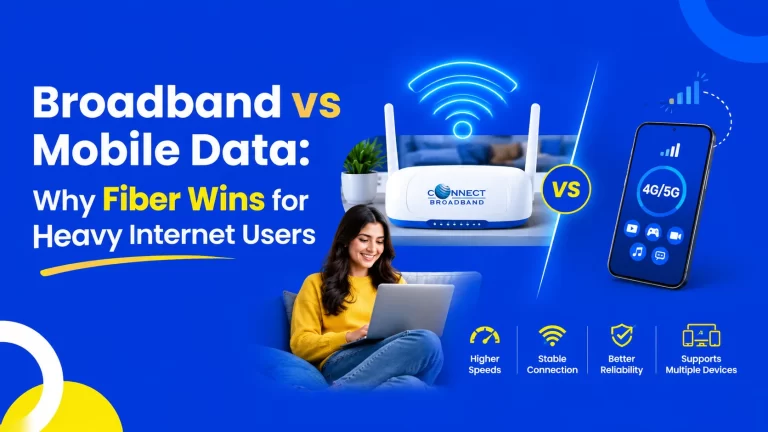
Across all these technologies, one requirement is consistent: fiber broadband future readiness.
What fiber does better
- Higher speeds (symmetrical upload/download)
- Lower latency
- Greater reliability
- Easier scalability
Copper-based networks were not designed for today’s data loads, let alone future demands.
Common Mistakes Users and Businesses Make
As internet demand grows, many still underestimate their needs.
Mistake 1: Focusing only on download speed
Upload speed and latency are just as important.
Mistake 2: Ignoring stability
Frequent drops cause more damage than slightly lower speeds.
Mistake 3: Planning only for today
Future technologies require headroom, not just minimum requirements.
Practical Advice: Preparing for Rising Internet Demand
Whether you’re a homeowner or a business, preparation matters.
What users should consider
- Choose connections with scalable speed options
- Prioritize fiber where available
- Use modern routers and WiFi standards
- Monitor device usage regularly
What businesses should plan for
- Redundant connections
- Cloud-ready infrastructure
- Security alongside speed
FAQ: Future Technologies and Internet Demand
Will internet demand continue to grow in the next 10 years?
Yes. Global data traffic is expected to grow exponentially due to AI, IoT, and immersive technologies.
Is fiber broadband better than traditional broadband for future needs?
Fiber offers higher speeds, lower latency, and better scalability, making it more future-proof.
Do smart homes really need high-speed internet?
Yes. Multiple devices running simultaneously require stable, high-capacity connections to function properly.
Can wireless networks replace fiber?
Wireless networks still depend on fiber backhaul. Fiber remains the foundation of future connectivity.
Why will future technologies increase internet demand?
Because they rely on real-time data, cloud processing, and multiple connected devices operating simultaneously.
Which technologies consume the most internet?
Smart homes, AI systems, cloud computing, AR/VR, and smart city infrastructure.
Is high-speed internet necessary for future technologies?
Yes. Speed, low latency, and stability are essential for reliable performance.
Final Thoughts
Future technologies are not just changing how we use the internet; they are redefining what the internet must deliver. As future technologies and internet demand grow together, high-speed, stable connectivity becomes essential infrastructure.
Understanding this shift helps users, businesses, and cities make smarter decisions today, so they are ready for tomorrow.
Understanding this shift helps users, businesses, and cities make smarter decisions today, so they are ready for tomorrow.
The future will be connected. The question is whether the connection will be ready.